
Weight forecasting
See your weight into the future
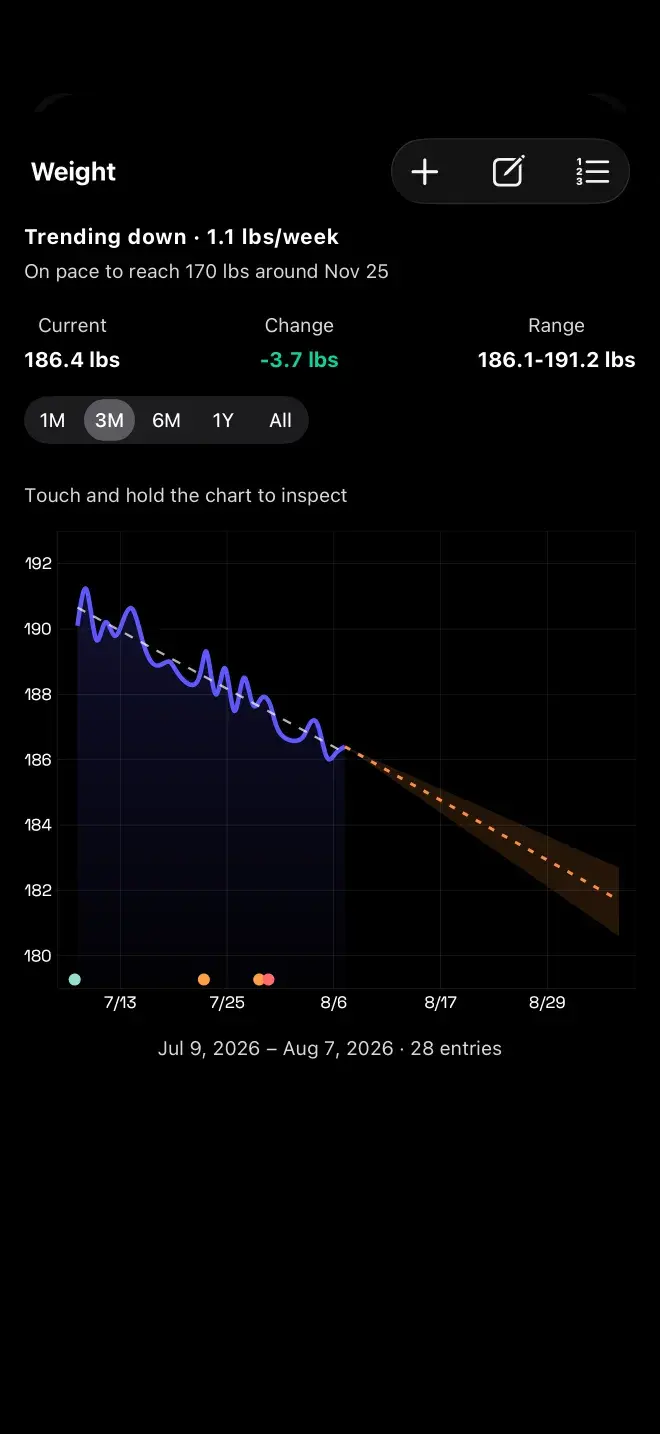
Log your weight regularly and Food Loops fits a trend through your real weigh-ins, projects it forward, and draws a confidence band around the projection. Recent readings count for more, outliers are thrown out, and when the model isn't confident it tells you instead of guessing.
How the forecast is fitted
The trend is the signal
Day-to-day scale weight moves with water, sodium, carbohydrate, digestion and hormones, and those swings are routinely larger than a week of genuine fat loss. Reading individual weigh-ins is mostly reading noise.
So the app doesn't read them individually. It fits a line through the last six months of readings, weights the recent ones more heavily, discards the outliers, and projects what's left forward — with a band around it that says how much the model is willing to commit to.
The full explanation →Forecast Facts
How the model is fitted
Weigh-ins used
Last 180 days
Weighting
Exponential
Half-life
14 days
Outliers removed
IQR
Prediction interval
95%
Confidence rating
High / Med / Low
When confidence is low the app shows no goal date at all, rather than one it doesn't believe.
Fitted to your weigh-ins
The projection comes from the scale, not from your food logs. Six months of readings go in; a trend line and a goal date come out.
Recent weeks count for more
The regression is exponentially weighted with a half-life of about two weeks, so a change you made this month moves the line far more than one you made in the spring.
A band, not a promise
The shaded area is a 95% prediction interval. It widens the further out it projects, because that is honestly how much less the model knows about next month than about next week.
Steady loss, tighter band
How wide the band gets follows from how far your readings scatter around the fitted line. A steady rate of change leaves small residuals and a narrow band; weight that moves in fits and starts leaves a wide one.
So if your loss is holding a consistent rate — whatever is driving that, a GLP‑1 medication like Semaglutide, Retatrutide or Tirzepatide included — the fit has more to work with, and the projected date moves around less. That is just what a weighted regression does with a steady series.
Weigh under the same conditions
First thing in the morning, after the bathroom, before eating. Which time of day you pick matters far less than picking one and keeping to it — inconsistent conditions add scatter that has nothing to do with your actual trend.
It updates as you go
Every new weigh-in refits the line. Watch the projected date move as the trend responds to what you're actually doing, which is a good deal more motivating than a number that was fixed the day you set your goal.
Ready to see your future?
Log your weight for a couple of weeks and the forecast starts drawing itself. The more consistently you weigh in, the tighter the confidence band gets.