
Your plan
How your calorie target is calculated
Mifflin-St Jeor for BMR, an activity multiplier for TDEE, then an offset for your goal.
Your daily calorie target is your BMR multiplied by an activity factor to get TDEE, then offset by the rate of weight change you chose. The result is never allowed below 1,000 calories.
Step 1: BMR
Food Loops uses the Mifflin-St Jeor equation, generally considered the most accurate of the common BMR formulas: 10 × weight in kg, plus 6.25 × height in cm, minus 5 × age, then plus 5 for men or minus 161 for women. This is roughly what you'd burn lying still all day.
Step 2: TDEE
| Activity level | Multiplier |
|---|---|
Sedentary — little or no exercise | 1.2 |
Lightly active — 1–3 days a week | 1.375 |
Moderately active — 3–5 days a week | 1.55 |
Very active — 6–7 days a week | 1.725 |
Extremely active — heavy exercise or a physical job | 1.9 |
Step 3: the offset
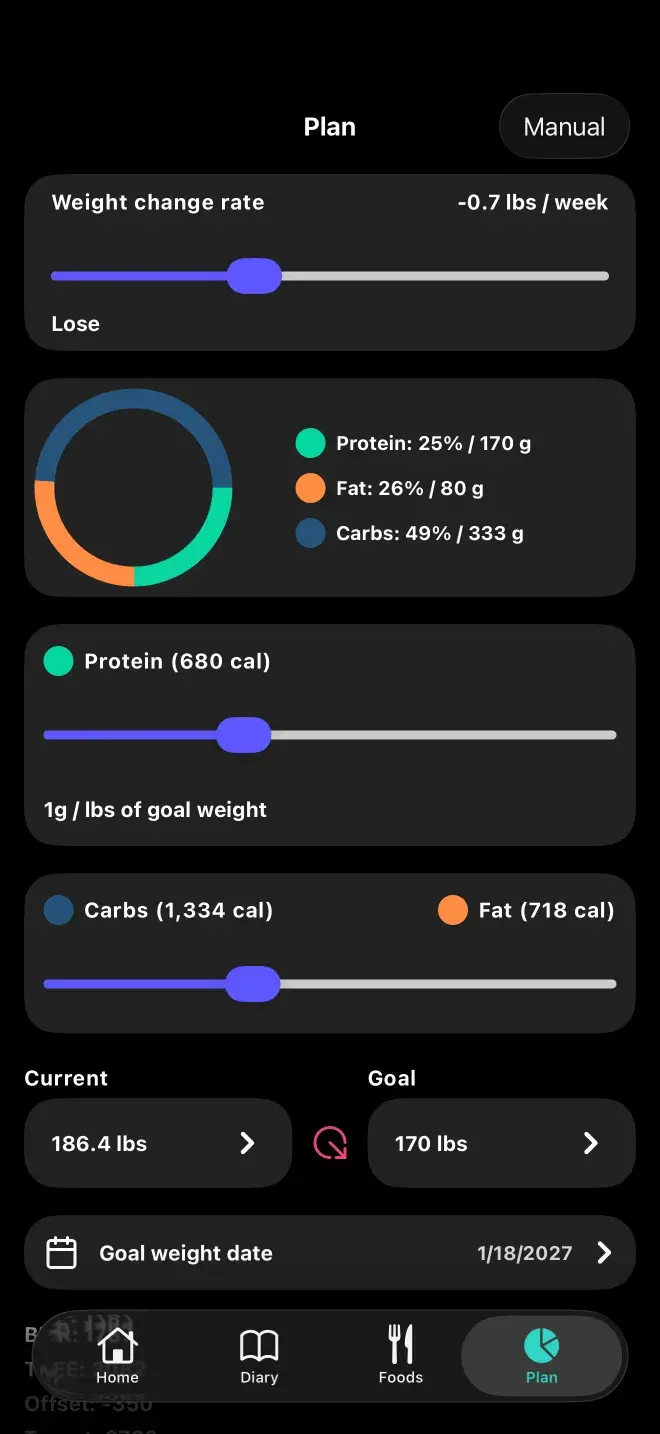
A pound of body mass is about 3,500 calories. Losing a pound a week therefore means eating about 500 calories a day below TDEE; two pounds a week means about 1,000. The direction comes from whether your goal weight is above or below your current weight, so you never enter a negative rate.
These are population averages. Individual metabolic rate varies by roughly 10% either way, so treat the number as a starting point and adjust after two or three weeks of consistent logging.
You can work the same numbers out on the web with the TDEE and macro calculator, which uses this exact code.
Previous
Combos and favoritesNext
Macro targetsStill stuck? Get in touch.