
Free calculator
Satiety Score Calculator
Foods with the same calories can differ greatly in how full they make you feel. This calculator scores any food from 0 to 100 on how filling it is per calorie, using the same model as the Food Loops app.
Start from a food, or enter your own numbers:
Per serving
71
/ 100
High Satiety
Very filling for the calories. Hard to overeat.
Score Breakdown
Weighted components
Protein35% of total
100 / 100
Protein is the most satiating macronutrient per calorie.
Fiber20% of total
0 / 100
Fiber adds bulk and slows digestion without adding calories.
Energy density25% of total
69 / 100
Calories per gram. Food that fills your stomach for fewer calories wins.
Palatability20% of total
96 / 100
Fat-plus-sugar, heavy sugar, and heavy salt override fullness signals.
Satiety Score
71 / 100
Energy density
1.65 kcal/g
Percentages are the weight each component carries in the final score, not a share of any daily allowance.
How this is calculated
Four components, weighted and summed. Each is scored 0–100 on its own before the weights are applied:
- Protein, 35%. Share of calories from protein. Half your calories from protein scores 100.
- Fiber, 20%. Grams per calorie. Thirty grams per 1,000 calories scores 100.
- Energy density, 25%. Calories per gram. At or below 0.6 scores 100; at or above 4.0 scores zero.
- Palatability, 20%. Starts at 100 and subtracts for fat-and-carb or fat-and-sugar overlap, for sugar above 20% of calories, and for sodium density.
A food measured in milliliters or fluid ounces is treated as a liquid: its energy density score is capped and the total is multiplied by 0.7.
Common questions
What is a satiety score?
A satiety score estimates how filling a food is relative to the calories it costs, on a scale of 0 to 100. Food Loops calculates it from four weighted components: protein as a share of calories (35%), fiber per calorie (20%), energy density in calories per gram (25%), and a palatability component that penalises fat-plus-sugar combinations, heavy sugar, and heavy sodium (20%). Scores of 0–33 are low satiety, 34–66 moderate, and 67–100 high.
Why do liquid calories score so low?
Liquids are less satiating than the same nutrition eaten as solid food, so the model multiplies the final score of any food measured in milliliters or fluid ounces by 0.7. A caloric drink also gets no credit for low energy density: without that rule, a sugary drink would score well simply for being mostly water.
What makes a food filling?
Protein is the most satiating macronutrient per calorie, fiber adds bulk and slows digestion without adding usable calories, and low energy density means a food physically fills your stomach for fewer calories. Working against all three is palatability: foods combining fat and sugar, or carrying heavy sugar or salt, are engineered to be easy to keep eating and override normal fullness signals.
Is a low satiety score bad?
No. Satiety measures how filling a food is per calorie, not how nutritious or healthy it is. Olive oil and nuts score low because they are energy dense, yet both are nutritionally valuable. The score is useful for deciding what to eat more of when you are trying to stay full within a calorie target, not for labelling foods good or bad.
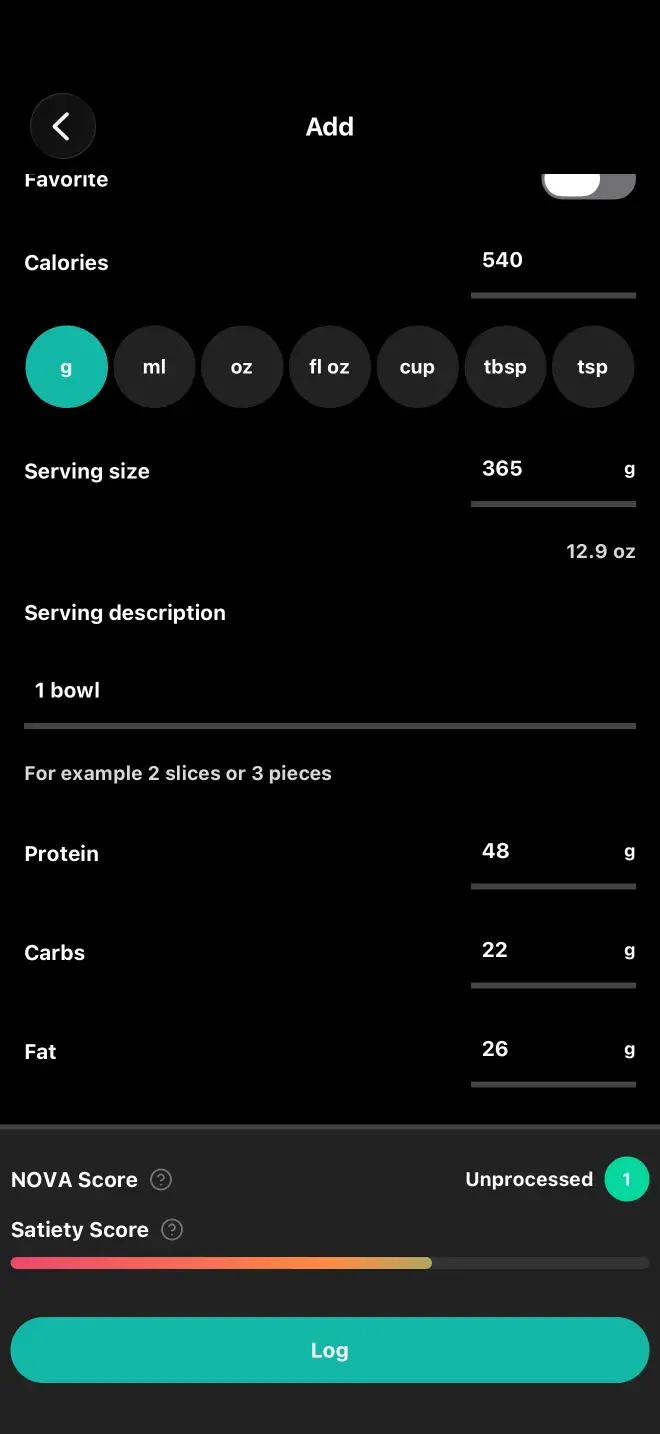
Every food you log gets scored
When you photograph a meal or scan a barcode, Food Loops adds a satiety score alongside the macros, helping you see which foods keep you full over time.
Read the guide →Not medical advice. These calculators are for information and education only. The formulas are population estimates and cannot account for your individual circumstances. Talk to a qualified healthcare professional before making changes to your diet, particularly if you have a medical condition or are pregnant. See the full disclaimer.